About Course
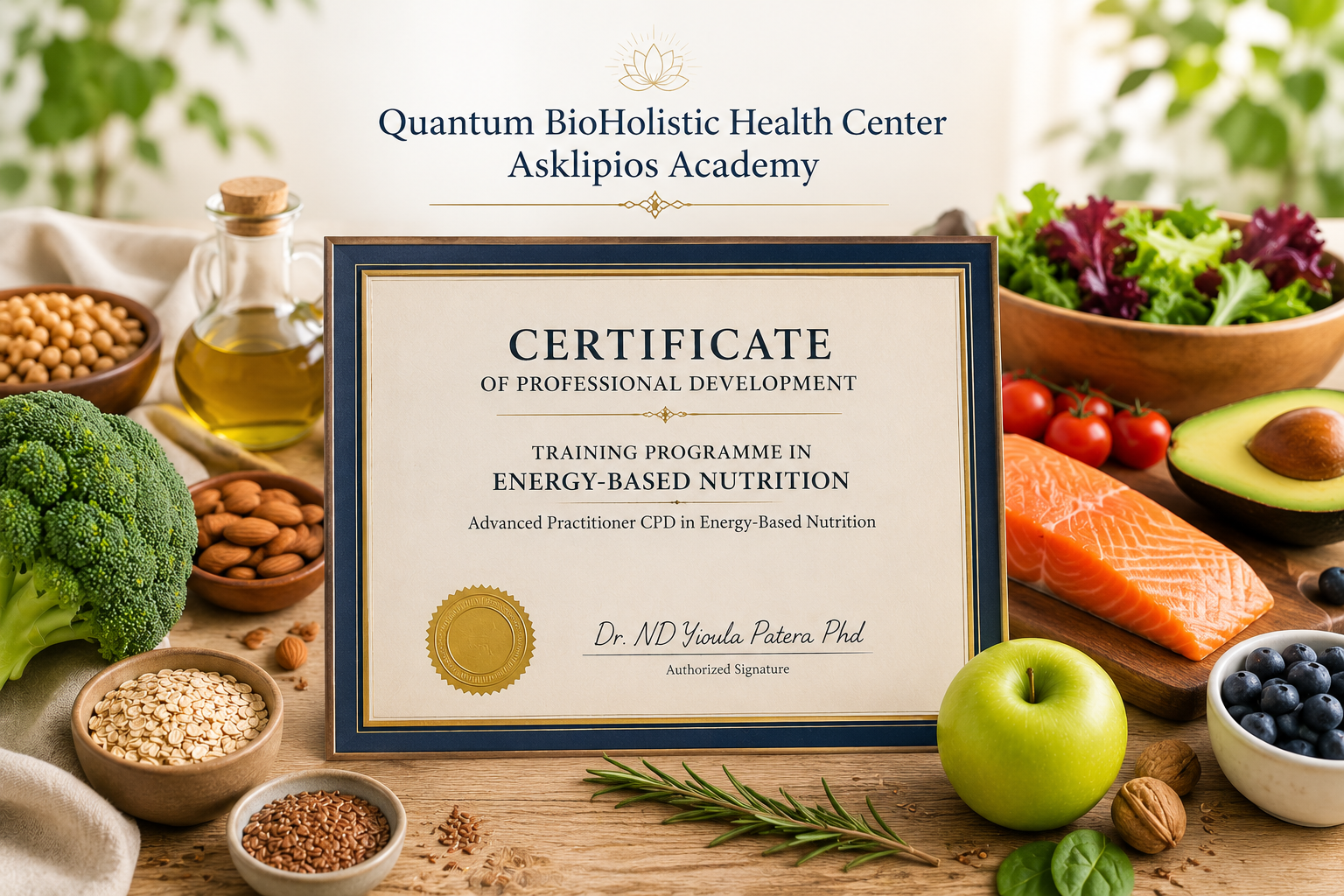
CERTIFICATE OF PROFESSIONAL DEVELOPMENT
TRAINING PROGRAMME IN ENERGY-BASED NUTRITION
Advanced Practitioner CPD in Energy-Based Nutrition
Provider: Quantum Bio Holistic Health Centre Asklipios
Programme Director: Dr. N.D. Yioula Patera, PhD
Language of Delivery: English
Programme Fee: €399
Total Duration: 50 hours
Introdution
What You Gain as a Learner
By participating in our Energy-Based Nutrition programmes, you develop:
- understanding of the relationship between food, energy, and daily balance
• skills of observation and conscious dietary choice
• the ability to interpret information responsibly, without over-interpretation or imposition
• clear awareness of professional role and boundaries
Learning is experiential, structured, and grounded in academic thinking.
Certification & Professional Development
Upon successful completion of each programme, a Professional Development Certificate is awarded, confirming:
- the total number of training hours
• the subject area (Energy-Based Nutrition)
• participation in a structured and assessed educational process
The certificate relates exclusively to professional and educational development and does not constitute:
- a professional licence
- an academic degree
- a regulated or therapeutic qualification
Learning with Integrity and Perspective
We believe that education in Energy-Based Nutrition should empower learners with understanding and awareness — not create dependency or confusion.
Our approach cultivates:
• responsible professional attitude
• academic maturity and critical thinking
• long-term, ethical, and conscious educational development
In this way, learning remains meaningful, credible, and aligned with recognised international educational frameworks.
What Will You Learn?
- Energy-Based Nutrition was created to bridge worlds that often remain separate: modern nutritional knowledge and the wisdom of traditional systems, theory and practice, what we eat and how we live.
- Our Energy-Based Nutrition educational programmes are designed for learners who seek clarity, academic structure, and meaningful professional development within the field of holistic nutrition education.
- Energy-based nutrition, as approached here, is not a trend. It is a return to balance.
- Our philosophy focuses on knowledge, responsibility, and long-term educational growth — not on promises, quick fixes, or rigid dietary models.
- Energy-based nutrition, as presented here, supports deeper “reading” of the body. It helps explain why certain patterns reappear, how food influences energetic balance, and how small adjustments can support improved self-regulation.
- The programme is intended for those who feel that health and wellbeing are not separate from daily life, but the result of small, conscious choices. It is also designed for professionals who wish to deepen their understanding with responsibility and respect, as well as for individuals seeking a more holistic and human-centred relationship with food.
Course Content
PROGRAMME STRUCTURE
-
Introduction, Information and Course video Introduction
14:29 -
Programme Contents
UNIT 1 – Introduction to Energy-Based Nutrition
-
Programme Overview & Unit 1 Video Introduction
09:42 -
1.1 Why We Speak About Energy-Based Nutrition Today
-
1.2 Food Beyond Calories
-
1.3 Holistic Approach: Body, Energy, and Lifestyle
-
1.4 Food as Information and Stimulus
-
1.5 Historical Perspective of Energetic Thinking in Nutrition
-
1.6 The Role of Awareness in Dietary Choice
-
1.7 Unit Closure – Preparation for What Follows
-
Unit 1 Assessment Quiz
UNIT 2 – Food, Energy and Human Balance
-
Programme Overview & Unit 2 Video Introduction
10:25 -
2.1 The Concept of Balance in the Human Being
-
2.2 Food and Vital Energy in Daily Life
-
2.3 The Relationship Between Food and the Nervous System
-
2.4 Internal Signals and Self-Observation
-
2.5 Energetic Needs of the Modern Individual
-
2.6 Food, Emotions, and Energetic State
-
2.7 Cultivating Balance Through Small Changes
-
2.8 Unit Closure – From Theory to Experiential Understanding
-
Unit 2 Assessment Quiz
UNIT 3 – Traditional Chinese Medicine and Five-Element Nutrition
-
Programme Overview & Unit 3 video Introduction
10:27 -
3.1 A Different Perspective on Nutrition
-
3.2 The Concept of Yin and Yang in Nutrition
-
3.3 The Five Elements as a Map of Understanding
-
3.4 Thermal Nature of Foods
-
3.5 Nutrition in Relation to the Seasons
-
3.6 Individual Needs and Flexibility
-
3.7 Integrating the Philosophy into Daily Life
-
3.8 Unit Closure – Nutrition as a Natural Flow
-
Unit 3 Assessment Quiz
UNIT 4 – Ayurvedic Nutrition and Energetic Types
-
Programme Overview & Unit 4 video introduction
09:32 -
4.1 The Philosophy of Ayurveda
-
4.2 Energetic Qualities: Vata, Pitta, and Kapha
-
4.3 Nutrition and Balance of Energetic Types
-
4.4 The Role of Digestion and “Inner Fire”
-
4.5 Rhythm, Routine, and Daily Stability
-
4.6 Flexibility and Dietary Adaptation
-
4.7 Practical Integration of Ayurvedic Principles
-
4.8 Unit Closure – Respect for Individual Uniqueness
-
Unit 4 Assessment Quiz
UNIT 5 – Modern Nutritional Science within a Holistic Framework
-
Programme Overview & Unit 5 video Introduction
10:15 -
5.1 Why We Need Modern Science within a Holistic Approach
-
5.2 Macronutrients: Beyond Quantities
-
5.3 Micronutrients and Food Quality
-
5.4 Bioavailability and Assimilation
-
5.5 Nutrition, Inflammation, and Everyday Load
-
5.6 The Concept of Balance in Modern Practice
-
5.7 Scientific Knowledge and Personal Experience
-
5.8 Unit Closure – Integrating Knowledge and Practice
-
Unit 5 Assessment Quiz
UNIT 6 – Gut Health, Microbiome and the Gut–Brain Axis
-
Programme Overview & Unit 6 video Introduction
00:00 -
6.1 The Gut as a Centre of Balance
-
6.2 The Microbiome and Individual Uniqueness
-
6.3 Communication Between the Gut and the Brain
-
6.4 Digestion, Rhythm and Sense of Safety
-
6.5 Nutrition and Gut Balance
-
6.6 Emotions and Gut Experience
-
6.7 Gradual Support and Patience
-
6.8 The Gut as a Mirror of Wellbeing
-
Unit 6 Assessment Quiz
UNIT 7 – Conscious Nutrition and Energetic Quality of Food
-
Programme Overview & Unit 7 video Introduction
00:00 -
7.1 What “Conscious Eating” Means
-
7.2 Our Relationship with Food
-
7.3 The Energetic Quality of Food
-
7.4 Colour, Form, and the Presence of Food
-
7.5 The Role of Rhythm and Pause
-
7.6 Conscious Choice Without Guilt
-
7.7 Nutrition as an Act of Care
-
7.8 Unit Closure – Presence and Connection
-
Unit 7 Assessment Quiz
UNIT 8 – Nutrition, Lifestyle and Long-Term Conditions
-
Programme Overview & Unit 8 video Introduction
10:12 -
8.1 When Daily Life Becomes a Determining Factor
-
8.2 Long-Term Strain and Energetic Fatigue
-
8.3 Nutrition as Support, Not Correction
-
8.4 The Relationship Between Nutrition and Stress
-
8.5 Daily Habits and Long-Term Wellbeing
-
8.6 The Role of Empathy Toward the Body
-
8.7 The Educational and Advisory Role of the Practitioner
-
8.8 Unit Closure – Stability, Not Intensity
-
Unit 8 Assessment Quiz
UNIT 9 – Applications and Case Studies
-
Programme Overview & Unit 9 video Introduction
10:35 -
9.1 From Knowledge to Practice
-
9.2 The Value of Case Studies
-
9.3 Reading Energetic and Nutritional Patterns
-
9.4 Application at an Individual Level
-
9.5 Application within a Professional Wellbeing Context
-
9.6 Connection with Observation and Biofeedback Tools
-
9.7 Boundaries, Ethics, and Responsible Application
-
9.8 Unit Closure – Practice as a Space for Learning
-
Unit 9 Assessment Quiz
UNIT 10 – Professional Application, Boundaries and Ethics
-
Programme Overview & Unit 10 video Introduction
08:38 -
10.1 The Role of the Wellbeing Professional Today
-
10.2 Professional Boundaries and Role Clarity
-
10.3 Ethics and Respect for the Individual
-
10.4 Responsible Communication and Language
-
10.5 Integrating Knowledge into Professional Environments
-
10.6 Continuous Professional Development
-
10.7 Self-Care of the Professional
-
10.8 Programme Closure – Returning to the Essence
-
Unit 10 Assessment Quiz
Suggested Bibliography
-
Suggested Bibliography
Student Ratings & Reviews